We've moved! The Art in Science has a new home at taiscience.com

Monday, 8 November 2010

Microwaving CDs...don't try this at home!

I have added procrastination to the list of skills I've mastered and, in a bid to impart this wisdom to my faithful readers, I am going to share with you what I've been doing this cold and drizzly Monday evening.

Today's post is about microwaving CDs but please, please, please do not try this at home (or do, but absolutely, definitely DO NOT hold me responsible. Not even a little bit.  Nada)

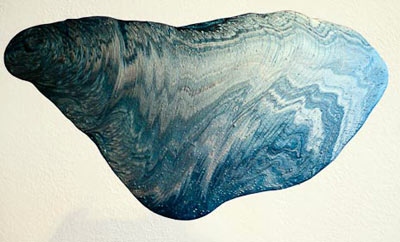
When you put a CD in the microwave for a few seconds (this is not a recipe...but no more than three seconds) the aluminium concentric circles are vaporised and you are left with this nifty little piece of art (right).

If you were to put a CD in the microwave, you would make sure that it was stood up against a glass and that you stopped the microwave when the CD started smoking.  Of course you know those fumes are very dangerous and shouldn't be inhaled.  But you won't try this at home so it doesn't matter.

The few seconds of arcs being created around the CD makes for a miniature electrical storm sparking away in your microwave (or your neighbours' if your flatmates are odd and don't own one).

You can watch this video at Powerlabs showing you what it looks like since you aren't going to do this at home.

When the little lightning party ends, one must be careful not to touch the CD right away (not You, no one's accusing You).  The CD can still be conducting currents for a few seconds after microwaves are present.

'How the heck does it work?', you may be wondering. Well, the thin layer of aliminium is vaporised by the microwaves and this vapour supports the flow of electricity.  With me so far?  Okay, well arcs form (like those from clouds to the ground - lightning), which continue to vaporise a trail along the circular tracks where data is stored.  This happens until the space between the tracks becomes too great to support an arc.  

...and what you are left with is seen below.  This is not one I did, my attempt (in safe laboratory conditions with all safety precautions taken) was pretty special but I couldn't get a decent photograph with my camera!


 Arianna Gianola, Princeton University gave it a good shot

So, the moral of the story is; if you're bored and have CDs from the 80s kicking around the house don't put them in the microwave*.  

*Unless you have a very well ventilated room, only put it in for 3 seconds, don't mind the prospect of your microwave exploding, wait very patiently once it's finished and take amazing pictures to share with me afterwards.  Then and ONLY THEN may you try this at home


Sunday, 24 October 2010

This is NOT just photography

The Wired Science blog  is undoubtedly one of the best science blogs on the net, being accessible for the laymen but diverse and in-depth enough to keep all interest-levels happy. Last week, however, one post stood out among the rest. The announcement of the top 20 microscopic photographs in the 36th annual Nikon Small World competition.


The 20 photos that popped up on my screen were unrecognisable at first glance and unbelievable upon closer inspection.  These photo's are truly phenomenal!  Take a look at the winner:


'Can you guess what it is yet?' (in my best aussie accent).  No?  Well it's the heart of a mosquito, magnified 100 times!  Betsy Mason at WIRED said that
'The image, which used flourescence technology to highlight different parts of the specimen, stood out as one of the most beautiful of the entries. And it also had scientific merit as part of the photographer’s research on how mosquitoes carry and spread disease.'
Below is a pick of my personal favourites but you can take a look for yourself at the Wired Science blog.
Ichneumon wasp compound eye and antenna base (40X), Reflected (Episcopic) Light Illumination 
Telophase HeLa (cancer) cells expressing Aurora B-EGFP (green) (100X)
Zebra Fish olfactory bulbs (250x)
Ctenocephalides canis (flea) (20X)
...and if you can't get enough of photomicrography, you can visit the Nikon Small World website.

All images courtesy of Nikon Small World

Tuesday, 19 October 2010

The Painter and the Pendulum

Tom Shannon is an extremely talented and creative painter and scientist.  His work, based around the magnetic and gravitonal fields, centrufugal force and fluid dynamics of the universe demostrate the forces and fields acting on the Earth and the Sun.  I will leave the explanation to Tom, but enjoy this video and listen carefully to Tom's musings on the universe and nature, he's a smart man.

Tuesday, 12 October 2010

Size Does Matter

Now that I’ve got your attention, have you ever stopped to think about the importance of our perception of scale? No, me neither. Until now. I mean, at one end of the ‘scale’ we have incomprehensibly small particles making up the entire universe and at the other, distances measured in the equally mind-boggling lightyears*, millions of which it would take to even dip your toes in that pool of matter.

*If, like me, your year 5 physics is jumbled up in your head somewhere between mottle and daub medieval huts and the formation of an oxbow lake, let me remind you; A lightyear is the distance that light can travel in a year!).

Yet, visually, on a day-to-day basis we all perceive the world on the same scale, or so it seems. The Measure for Measure art exhibition at Gallery 825 Los Angeles, explores the ability of art to experience and perceive the size and scale of what we see.

Whilst oscillating strings vibrating to create the universe (see my previous poem: String Theory) is difficult to conceive, the art in Measure for Measure makes tangible the conceptually dramatic boundaries that we meet in science.

Lisa Randall, curator, explains ‘I wanted a theme where both art and science could participate and it wasn't just art representing science or science pretending to be art, but where we could think deeply about ideas that underlie both of them’

The exhibit consists of work from seven artisits and includes painting, sculpture, images, installations and videos. Prominent in many of the installations were mirrors, their reflections creating swollen and shrunken worlds-within-worlds.

Unfortunately, for my predominantly-English audience, the exhibition was in Los Angeles, however, you can peruse the following pictures form the exhibit and read more about the exhibit at the Measure for Measure website.

Image: Anita Bartlett  Susan Sironi's 'Actual Size' - A Portrait in Four Parts
Sironi took illustrated classics like 'Gulliver's Travels' and 'Through the Looking Glass', then carving to-scale tracings of her body parts into them using a surgical scalpel.
'Measurements of Space in a Fractal Structured Vacuum', Artist Felicity Nove 'created paint pours reminiscent of supernova explosions and black holes on the Hubble website'.


'Meeson Pae Yang's Structures installation explores diatoms, groups of algae that make up a large component of the earth's biota.'


Images copyright of Los Angeles Art Association.  For details of all images sources and references please contact me directly.

Monday, 20 September 2010

Michelangelo: Secret Scientist

Michelangelo Buonarroti, know only by his first name to his mates, began dissecting corpses from a church graveyard in his teens, then, from 1508 (probably why he’s a bit famous) he began painting the roof of the Sistine Chapel in Rome. Michelangelo was famously an artisitic genius, sculptor, architect and, the hidden gem in his professional repertoire; an anatomist! Although this is something that no doubt aided in his drawing of extremely accurate human depictions, Michelangelo concealed this side of himself by destroying almost all of his anatomical sketches and notes. However, artists (and nerds too) have been scrutinising his work for decades looking for hints at his secret double life and boy did they find a corker!

Back in 1990, Frank Meshburger proposed that in the famous central panel, God creating Adam was a depiction of the human brain in cross section.  See for yourself.


Meshberger 'speculates that Michelangelo surrounded God with a shroud representing the human brain to suggest that God was endowing Adam not only with life, but also with supreme human intelligence.'  However, some interpret these findings as a confirmation of many atheist's beliefs, that God originates in the brain of man, that he is a creation of the mind.

A new study by Johns Hopkins Researchers published in the May 2010 issue of the Scientific Journal of Neurosurgery claims to have found further evidence of hidden anatomical diagrams of the brain amongst the paintings in the Vatican’s Sistine Chapel. They believe that God’s neck is a concealed diagram of the brainstem and other neighbouring regions of the brain. Check out these pictures

In this panel, The Separation of Light from Darkness, Ian Suk and Rafael Tamargo have found a ‘precise’ depiction of the human spinal cord and brain stem leading up the centre of God’s chest and forming his throat.

R Douglas Fields tells us that “Art critics and historians have long puzzled over the odd anatomical irregularities in Michelangelo’s depiction of God’s neck in this panel, and by the discordant lighting in the region”. I am not sure this is the answer they were after.

from Pixwit.com
Now some interpretations seem a little far fetched, after all, this is only speculation and Michelangelo’s true ‘meaning’ for painting the neck the way he did; or the brain-shaped shroud just so; died along with him. Some believe that Michelangelo was playing a cruel joke on his paymasters by putting God inside the human brain – the implication being that that is where God resides, as a thought of man only. Is the Sistine Chapel a vast biological puzzle, painted under the nose of Pope Julius II? A jigsaw only just beginning to be pieced together? Or, are we reading too much into this? I mean, I can certainly see the ‘brain’ in the image but at the same time, our clever little brains do 'like’ to make associations between recognisable images and the abstract, but saying that, I have seen quite a few brains in my time and that shape is pretty ‘brainy’.  Sacrilidge or homage? You decide.

For details of all references and image sources please email me.

Wednesday, 8 September 2010

Green Tea and the Fashionable bacteria

Okay, so this story has been making the rounds on the blogosphere for some time now but for those of you who have not yet cyber-stumbled upon this little fashion revolution, you’re in for a treat!


Suzanne Lee’s BioCouture exhibition at the Science Museum last month brought together years of hard work...fermenting green tea in order to make jackets.  Yes you read that correctly.  Lee, a senior research fellow at Central Saint Martin’s School of Fashion and Textiles, has created garments of eco-friendly, throwaway fashion from the cellulose produced by bacteria.  The process (put somewhat crudely) involves throwing the bacteria in a bath and mixing it up with some sweetened tea and yeast.

Ecouterre explains that, from this, "fibres begin to sprout and propagate, eventually resulting in thin, wet sheet of bacterial cellulose which can be molded” over a manikin into the desired shape.  You can then overlap these sheets which fuse together as the moisture evaporates.  When dried, the fibers develop a “papyrus-like surface” that can easily be stained with vegetable dies to create colours ranging from deep purple (beetroot) to bright yellow (turmeric).


Now, if you’re already searching for your nearest stockist, just hold tight for the next paragraph as I explain to you what one of these sexy little numbers will do in the rain! 

These garments are the firm textile they are because of the evaporated moisture.  Add that moisture back (cue English weather) and you are basically swimming in that same microbial soup it started out in.  The garment will swell considerably before turning into a gooey, cellulose-y mess.

Now, whilst clothing made from the same microbes used to ferment green tea may not be your idea of a staple piece in your capsule wardrobe this season, Lee's work does provoke larger questions about where fashion comes from and, particularly when developed from its nascent stages,  proposes the idea of truly sustainable clothing; fashion that, when worn out, can be tossed in the compost bin with your eggshells and teabags.

Tuesday, 31 August 2010

Left or Right? It's a no-brainer!


Todays lesson post is Brain Function 101.  ‘Where’s the art in that?’ I hear you cry, well, friends of The Art in Science, the art is in the right side.  Okay, so that’s perhaps a little elementary, however, the brain is split into two halves, or hemispheres, and their functions really do differ...like, a lot!


Everybody has a ‘dominant side’ of the brain so before you get stuck into this post (as if you aren't already), know that, by the end, you will know which camp you can set up in; you’re a right- ,or a left-brainer and there’s no avoiding it.  

Okay, so maybe it’s not just so cut and dry.  The learning and thinking process is enhanced when both hemispheres work in a balanced way; kind of like getting two children to paint one picture, if one kid is too dominating, the other is bound to go off in a strop and will sit redundant, whimpering in the corner.  If, however, both participate equally, not only will the painting get finished, but it might even be worthy of sticking to the fridge with an RSPB fridge magnet.

Okay, child-friendly analogies aside, let’s clear up the characteristics of each side and try and work out which is you dominant side.  

Left Hemisphere
Right Hemisphere
Rational Side
Intuitive side
Logical
Analogic (sees correspondences and resemblances)
Problem solver (looks sequentially at the parts of things, not just the whole)
Problem solver (looks for patterns and configuration – uses hunches)
Draws on previous accumulated, organised information (present and past)
Draws on unbounded cluster of images and patterns (present and future)
Prefers talking and writing
Prefers drawing and tactile action
Prefers multiple choice
Prefers open-ended questions
Controls feelings
Free with their feelings and emotions
Prefers established hierarchy and authority
Prefers shared power and team responsibility
Responds to verbal instructions
Responds to images, symbols, diagrams or demonstrated instructions
Prefers math and science
Prefers ‘meaning’ (philosophy and religion)
Is practical and forms strategies
Imagination rules, presents possibilities


Whilst it’s not left=scientist, right=artist, it is clear to see that different people's minds work and respond to the world around them in quite different ways.  As far as I can see, I am skilled in all areas of both (I am ridiculously smart, AND I heart images), although if I were pushed to make a decision (stop pushing me), I would say I am probably a right-brainer but have my left brain well trained!


That is the key: whichever side of the brain you have discovered best describes your thinking and problem solving style, concentrate on the traits of the other.  Therefore, the more adept you will become at each of the 'non-dominant' traits and the better your brain will work as a unified whole (remember the kids painting?).  So my advice to you is to not invest in brain training software named after a fictional Japanese neurologist, but instead, focus on exactly what your brain needs and use its plasticity to your advantage.  You can teach an old dog new tricks (although the brain does get less neuroplastic (fact-spongey (I coined that phrase, remember the name (too many brackets? (it’s okay, it’s good practice for your left brain)))) as you age so make haste!)